
Young Barbican Takeover 2026
Is anyone there?
29 March 2026
A curated a short film programme as part of the Young Barbican Takeover that delves into the volatile nature of communication. Each film reflects SplicD’s belief that film and cinema can be used as a liminal space to explore and communicate narratives that may be hard to verbalise through other mediums.
From the unspoken dynamics of family relationships to the misunderstandings of learning a new language as a child, these works reveal how meaning is often shaped by silence and translation as much as by speech itself.
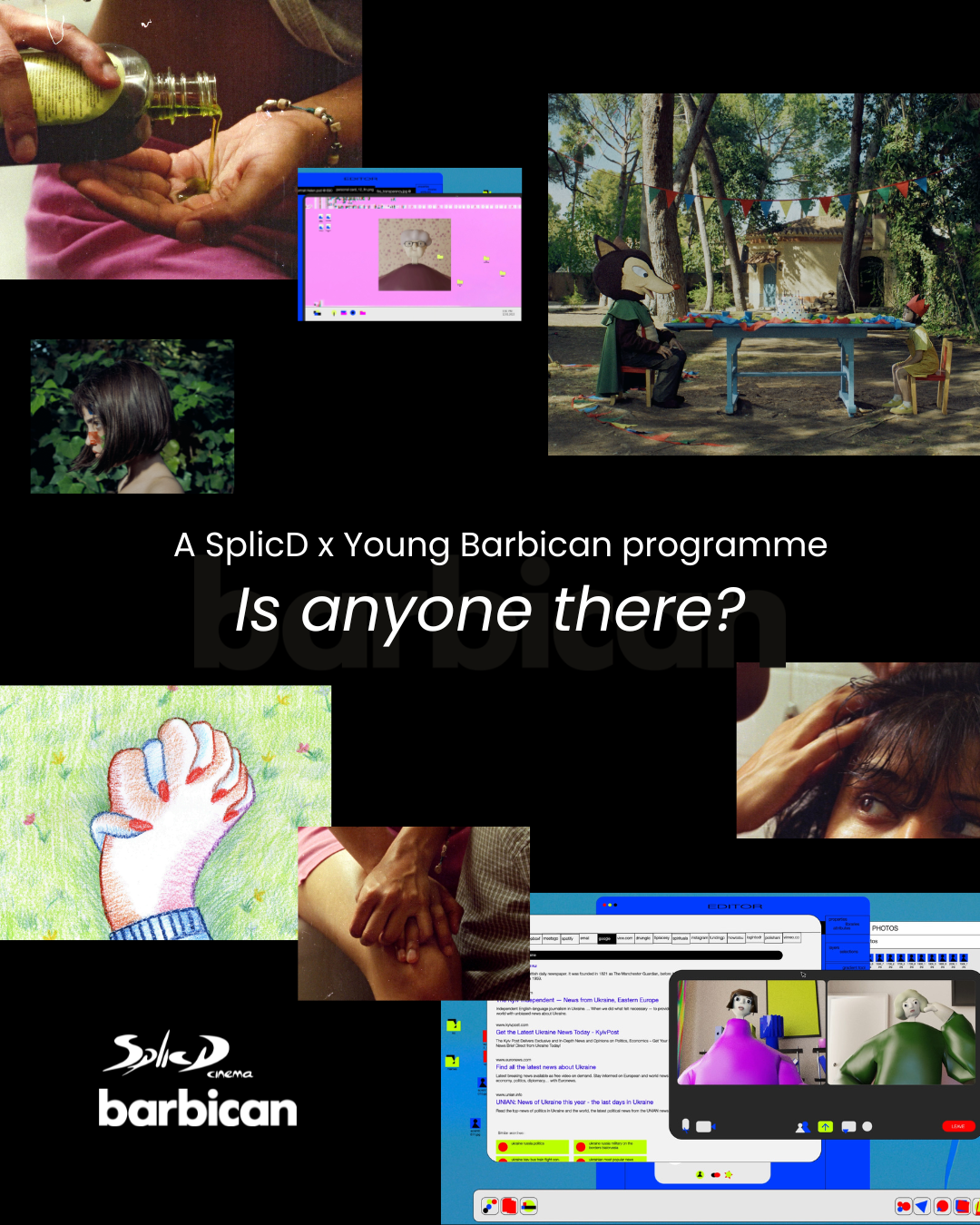
Parental relationships are also the focus of our third short, Can You Hear Me? (2025) by Anastazja Naumenko. Here, the director teaches her mother how to use her laptop over Zoom. However, each lesson gets sidetracked as the screen they inhabit becomes a space for conversations that have previously been glossed over. Between screens freezing and unsuccessful copy and pasting exercises, exchanges become deeper, shedding new light on old memories and prompting us to question how much we actually know our parents.
The final film, A KIN SIN (2024) by Gulzar, invites the viewer into the protagonist’s bathroom, where our main characters reflect on the boundaries of familial love and explore the tension between living up to your parents’ expectations and wanting to be your own person. With its joyful ending, it beautifully wraps up this collection of shorts and leaves us with the hopeful reminder that even when language falls short, the chance of being truly heard makes it worth speaking.
We open with Cabbage Daddy (2026) by Grace An, a humorous animated short about the linguistic mishaps of a young bilingual child switching back and forth between English and Korean. Rife with puns and misinterpretations, it manages to capture both the challenges and the joys of growing up in a multilingual household.
We then plunge into murkier waters, following Campolivar (2025) by Alicia Moncholí Lueje as it shifts the focus from language to memory. In this dark tale about a daughter untangling memories of her father through pictures and recordings, the director uses the visuals of her childhood to turn a bleeding wound into art. With its water leitmotif and the progressive decay that pervades the film’s imagery, communication is not only halted but broken down, with childhood interpretations desperately being used to fill the leaks in the protagonist’s recollection of a complicated relationship.